For decades, elections in West Bengal have carried a grim footnote - political violence, often resulting in deaths and serious injuries. From the turbulent years of the late 1960s to the fiercely contested multi-party battles of the present, control over territory and the exclusion of rivals have shaped the state's electoral culture. But the 2026 Assembly elections have delivered an unprecedented shift: zero reported murders and no serious injuries, marking a significant break from this violent past.
The Numbers That Defined Bengal's Poll Violence
Over the past two decades, every major election cycle has seen deaths.
-2006 Assembly polls: 5 deaths
-2008 Panchayat polls: 45
-2009 Lok Sabha polls: 15
-2011 Assembly polls: 17
-2013 Panchayat polls: 20
-2014 Lok Sabha polls: 7
-2016 Assembly polls: 8
-2018 Panchayat polls: 75 (one of the deadliest elections)
-2019 Lok Sabha polls: 12
-2021 Assembly polls: 17
-2023 Panchayat polls: 57
-2024 Lok Sabha polls: 6
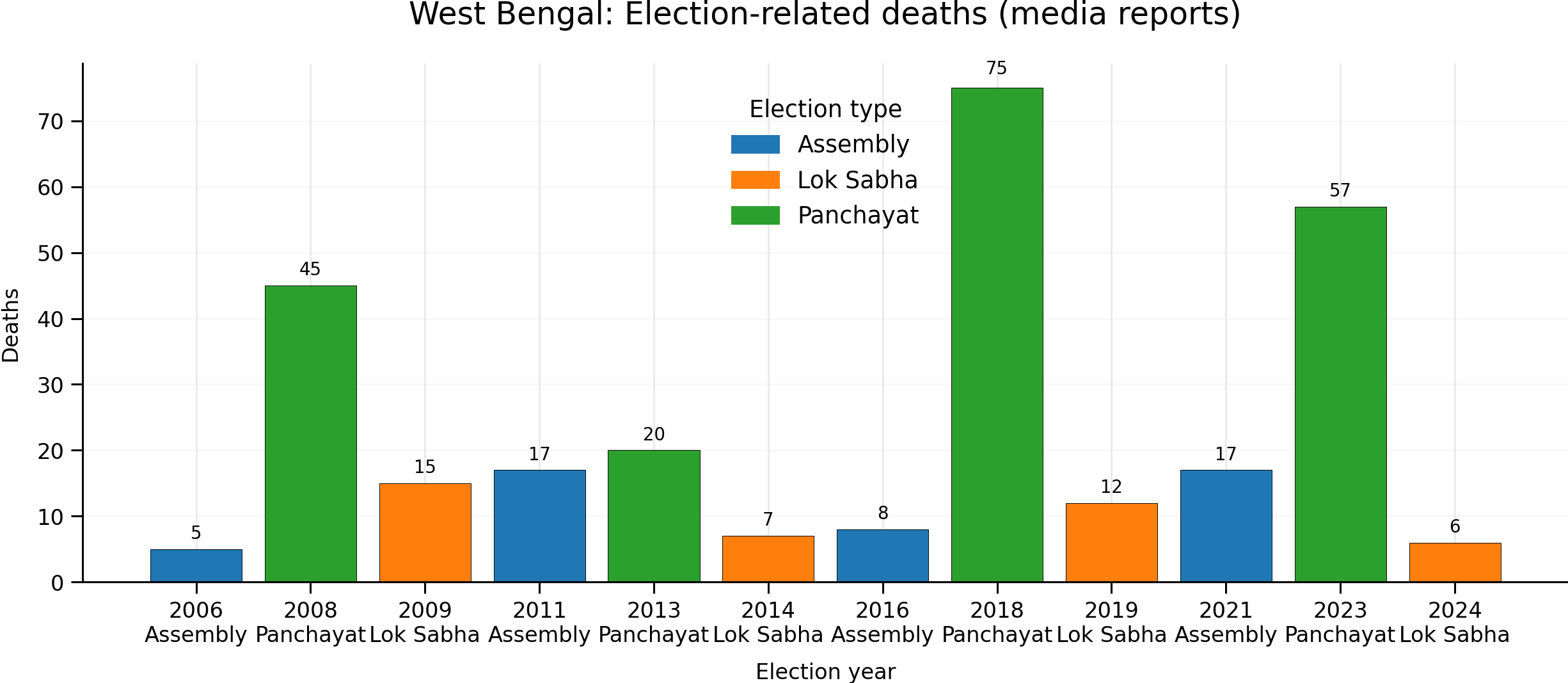
The trend is unmistakable: fatalities were routine, not exceptional, with local body polls often turning the most violent.
Also read: Analysis: Government Planning Underlines BJP's Confidence Ahead Of Bengal Results
NCRB and MHA Data: Evidence of a Systemic Problem
Beyond election-specific counts, broader datasets underline the structural nature of political violence:
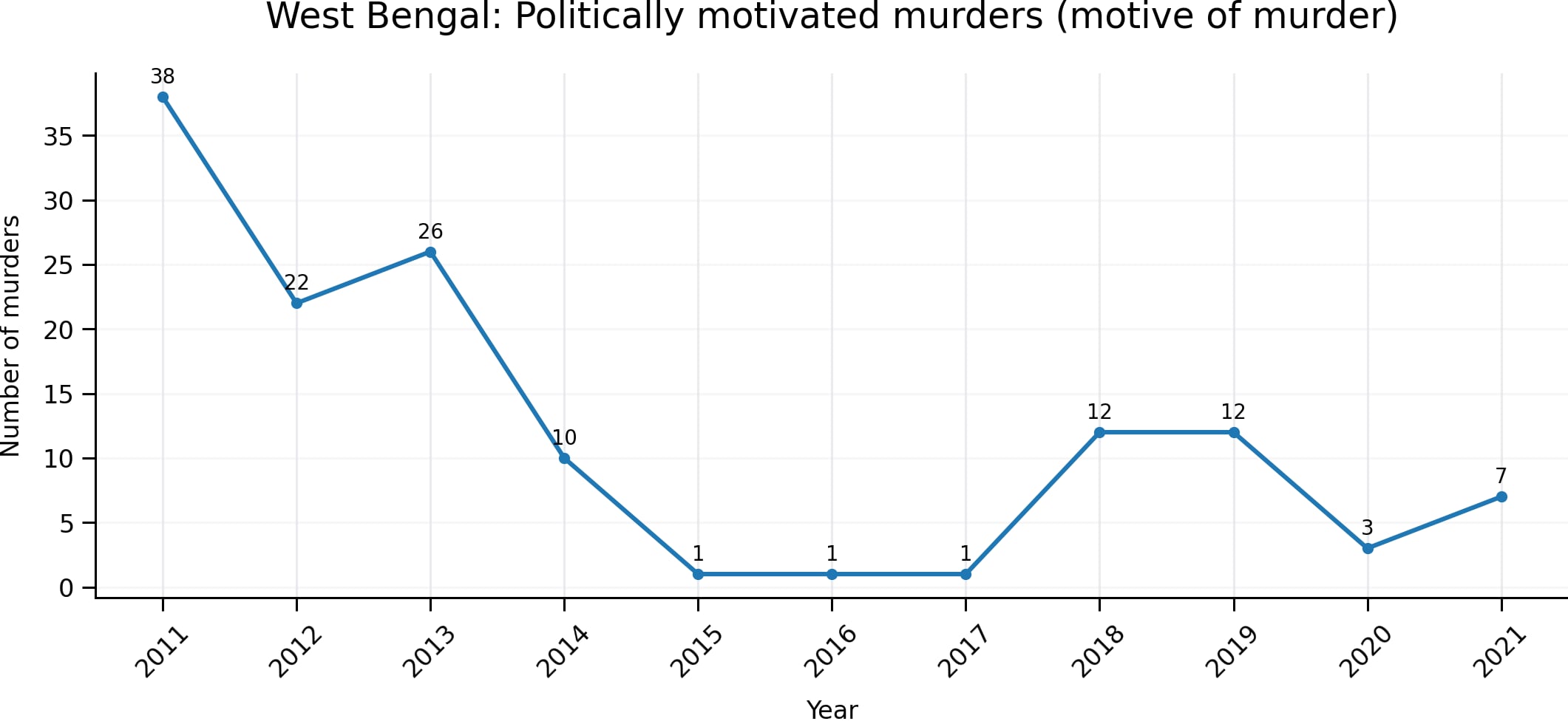
According to National Crime Records Bureau data, West Bengal averaged around 20 political killings annually between 1999 and 2016. NCRB figures under "motive of murder-political" show continued incidents.
-2011: 38
-2012: 22
-2013: 26
-2014: 10
-2015: 1
-2016: 1
-2017: 1
-2018: 12
-2019: 12
-2020: 3
-2021: 7
Also read: "Subversion Of Democratic Process": Bengal's Falta To See Repolling On May 21
However, the Ministry of Home Affairs disagree with the Bengal government data and wrote a letter to the state government. MHA says multiple sources suggest higher spikes in certain years.
-2016: 36
-2017: 25
-2018: 96
-2019: 26
These differences underline a key point: political violence in Bengal is persistent and, at times, underreported or contested in measurement.
Scale of Violence: NHRC Findings
The scale extends far beyond killings. A probe by the National Human Rights Commission into post-election violence of 2021 documented 1,900 incidents, including:
-29 murders
-12 sexual assault cases
-391 cases of grievous hurt
-940 instances of arson and vandalism
-562 cases of intimidation
Out of more than 9,300 accused, only about 1,345 were arrested - highlighting gaps in enforcement alongside political rivalry.
Historical Roots: Politics of Territorial Control
Politics in West Bengal exhibits a culture of protest. Between 1967 and 1971, the state witnessed widespread armed clashes, with guns and bombs becoming common in both rural and urban politics. Kolkata was marked by frequent bloody street battles, as rival political groups carved out exclusive zones of control, often denying even a nominal presence to opponents.
The 1972 elections under the Indian National Congress were widely associated with coercion, displacement of opposition workers, and large-scale rigging. The rise of the Communist Party of India (Marxist) in 1977 brought relative stability, but largely through the consolidation of political dominance across the state.
The emergence of the All India Trinamool Congress in 1998 disrupted that dominance, triggering violent rural contests for territory. Later, land movements in Singur and Nandigram reshaped political alignments, with mass mobilisation and confrontation becoming central to electoral politics. In the past decade, the rise of the Bharatiya Janata Party as a major challenger further intensified competition.
Across eras and parties, a consistent pattern emerges: electoral success has often been linked to territorial control, enforced through coercion and violence.
2026 Assembly Election: A Clean Break
Against this backdrop, the 2026 Assembly election stands as a complete statistical outlier with zero deaths.
From a historical range of 5 to 75 deaths per election, the number dropped to zero for the first time in at least two decades. Equally significant is the absence of serious injuries, which had previously run into hundreds.
This is not an incremental improvement; it is a structural break in the data trend.
What Changed: Central Forces and Enforcement
A key factor behind this shift was the scale of security deployment overseen by the Election Commission of India. Large contingents of central armed police forces, including the Central Reserve Police Force, were stationed across sensitive areas.
At the start of the election process, the Chief Election Commissioner assured citizens that the polls would be violence-free, intimidation-free, inducement-free, "chappa"-free (where a voter finds their vote already cast), booth-jamming-free, and source-jamming-free. Following two phases of polling, the state also recorded one of its highest voter turnouts since its inception, indicating both participation and confidence in the process.
This reduced the scope for local coercion and ensured a more neutral enforcement environment. For years, data from NCRB, MHA, and independent probes pointed to one conclusion: violence was embedded in Bengal's electoral process. The 2026 election challenges that assumption. Whether this becomes a sustained trend or remains a one-time exception will depend on future elections. But for now, the numbers tell a clear story.
from NDTV News- Special https://ift.tt/EjspwDH
Comments
Post a Comment